You may be able to just drill straight down and feed all the pipes from the top back to the manifold might save you some trouble.
That’s a good idea, there a TLDR description on why manifold is better than branching off? Seems like you would use more pex with the manifolds.
The third option is sometimes called ‘logic plumbing’
I like the home-run design for its overall simplicity. If something is leaking, it’s very easy to isolate it. And PEX is cheap. A little extra pipe for the sake of simplicity isn’t going to break the bank.
2 Likes
You do use alot more pex but if you do it right you will only have 2 connections one at the fixture and one at the manifold
1 Like
There’s a reason they only come with a 10 yr warranty if that.
1 Like
They do the same thing with copper, just the pex manifold looks slicker with the colors. My brother has a plumbing co and works only on word of mouth, does very well, hard to find good employees though. Commercial is where you normally see the copper run manifold.
I had a pex manifold in a house, and I have had copper. Can say as I prefer one over another, however, my brother strongly believes copper is far superior. Not M copper L copper, and not the asian copper imports, their stuff is inferior.
Copper is great as long as you are not on a well. That’s why they use it in commercial jobs.
Ok, @Jake_Lambert my water starts off fine, gets cooler fast, then the hot water kicks in again big time for a short period, then starts to cool off pretty quickly. That’s in the first person’s shower, the next person completely runs out of hot water pretty fast. Our heater is set on 120, and we’ve never had any trouble, even though we both take pretty long showers. This problem seemed to start suddenly, as in one day it was fine, the next we noticed this problem. Do you think that’s an element, or a bad thermostat? (And how would I test either of those?)
I can’t find an install or manufacture date anywhere, by the way.
Thanks in advance, Jake!
@Atlas1 sounds like the shower valve needs to be rebuilt not the water heater. Do you have the same hot cold problem at a different source like the kitchen? Also is it a single handle or two handle valve
Anthony could definitely be on to something; those balancing spools in the shower valve can be weird sometimes. But if the second person has literally no hot water, to me it points to a bad element too. I can walk you through the diagnostics with a multimeter (this is an electric tank, I’m assuming?) if you want; otherwise I’d be happy to come by on Sunday and do a diagnosis. I still owe you from my ride-along last fall 
3 Likes
Old plumbers trick after it runs out of hot water put your ear up to it if its heating you will hear it ping.
2 Likes
Yall two have become quite popular in the plumbing department @Jake_Lambert and @Firefighter4hire lol…
Thank yall again, wife ain’t complaining one bit.
3 Likes
Besides the farm plumbing was my very first real job. It is definitely a trade I’m glad I learned. So much has changed. Hard to even find a plumber that can pour a oakum joint
1 Like
First off, thank you (& @Firefighter4hire ) for the advice. Second, you can’t come by and do a free house call, and you owe me nothing. Third, I am a notch below “newbie grade” with a multimeter, but I can use one, so I welcome any diagnostic advice you want to give me.
(It is an electric water heater, and the second shower taker starts off with hot-ish water, they just run out quickly…Oddly enough, the weird temperature rollercoaster only happens in the first shower, never the second)
We only have one bathroom, and we don’t normally use enough hot water to notice any changes in how quickly it cools off anywhere else in the house.
Thanks guys!
BTW Thanks @Hotshot for starting this thread!
1 Like
I had to look that up. Fascinating stuff
1 Like
I would inspect the valve first the dip tub could be broke you could have a broken element. Probably not thermostat
2 Likes
@Infinity Pouring joints is a lost art. I loved to do it . It’s been a long time since I have had the need to do it. Most people just RIP it out and replace it. Which they should but have no idea how difficult it was to do compared to modern plumbing
Did you ever play around with “wiping lead”? Now THAT is an art! I worked on a house last year that had all lead DWV but a cast iron stack, the house was 150 years old or so. They ran lead pipes and just cut wherever they needed to make a connection, then made up lead fittings by hammering and stretching, melting both together and wiping the joint. Impossible to transition from that to anything modern; I had to rip everything back to the main stack for a single bathroom that someone sent a snake down and blew out the side. Broke my heart, the guys that built that were artists
3 Likes
Jesse, give me a call if you want me to walk you through the multimeter process; you’ve shared TONS of information with me about this business. It’s the least I can do!
The simplest test you can do is continuity on the elements themselves:
(1.) Flip the breaker to the water heater, and verify at the water heater to make sure there’s no current
(2.) Use a Phillips head to remove the two wires from the top and bottom elements
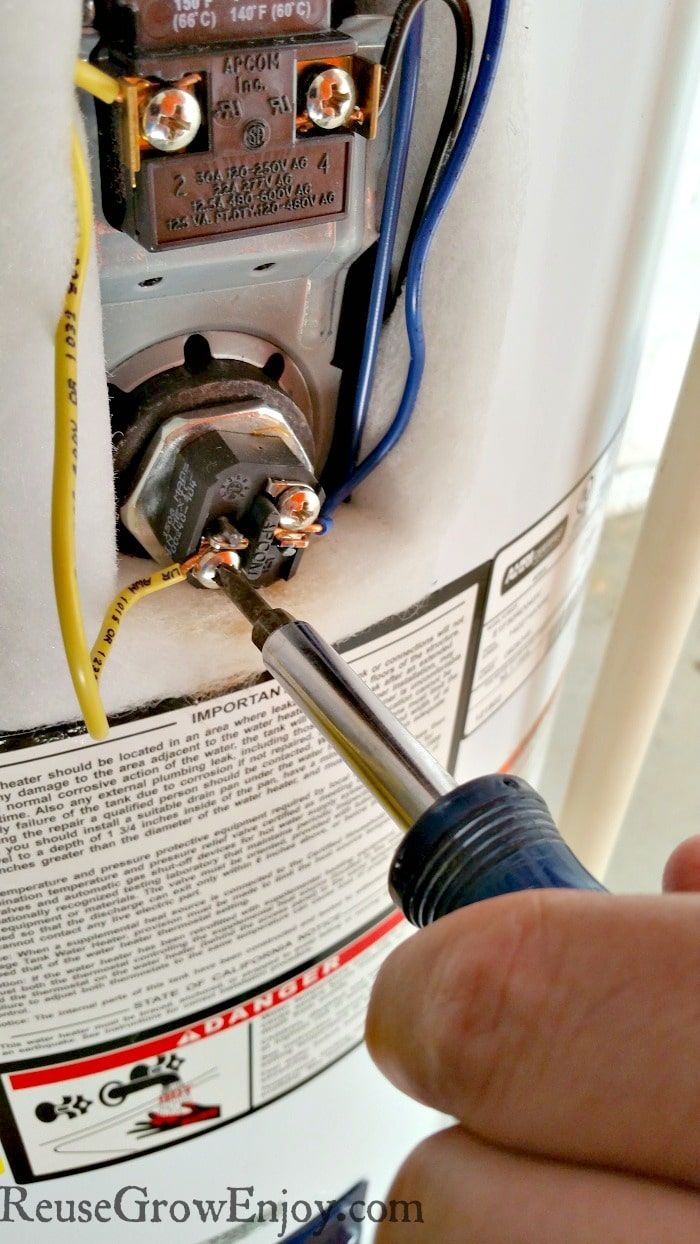
(3.) Use the continuity setting on your multimeter- it looks like an upside-down horseshoe or an omega symbol. Put one lead from your multimeter on one screw, and one on the other
(4.) You should read somewhere between 10 and 16 ohms. If it’s less than 5, you have an element going bad
(5.) If they both read good, give me a call. I love playing with water heaters

4 Likes